Skin Cancer Awareness Shouldn’t End with Summer
When summer ends, sunscreen and skin cancer prevention tend to fade from people’s minds. Beach days are replaced by cooler weather, shorter days and more time indoors. But while the conversation about skin cancer often focuses on summer, protecting your skin and recognizing potential warning signs remain important throughout the year.
In fact, fall and winter are excellent times to schedule a skin cancer screening, particularly for people who spent much of the summer outdoors or have other risk factors.
“People tend to think about skin cancer prevention when they’re heading to the beach, but this is actually a great time of year to make an appointment with a dermatologist,” says Matthew J. Finnegan, MD, a robotic general and colorectal surgeon with Shore Physicians Group. “If you spent a lot of time in the sun this summer, or you know you’re at higher risk, getting your skin checked is just good preventive healthcare.”
According to the American Cancer Society, skin cancer is the most common type of cancer in the United States. People with fair skin, freckles, light-colored eyes, blond or red hair, or skin that burns easily face an increased risk. Other risk factors include severe sunburns, frequent sun exposure, tanning bed use, numerous or unusual moles, and a personal or family history of skin cancer. People with weakened immune systems are also at increased risk.
Those who spend considerable time outdoors, including lifeguards, construction workers, boaters and gardeners, should be particularly mindful of their sun exposure.
Skin tone also plays a role in melanoma risk. According to the American Cancer Society, the lifetime risk of developing melanoma is approximately 3% for White Americans, compared with 0.5% for Hispanic Americans and 0.1% for Black Americans. However, skin cancer can affect people of every skin tone, and individual risk varies.
There are several types of skin cancer, including basal cell carcinoma, squamous cell carcinoma and melanoma. While all can become serious, melanoma is particularly concerning because it can grow deeper into the skin and spread to other parts of the body.
“One of the concerns with melanoma is that it doesn’t always look that serious on the surface,” Finnegan explains. “It can grow deeper into the skin, and the deeper it goes, the greater the risk of spreading. That’s why identifying these cancers early is so important.”
The American Academy of Dermatology recommends watching for the ABCDE warning signs of melanoma:
- A – Asymmetry: One half of a mole looks different from the other.
- B – Border: The edges are irregular, ragged or poorly defined.
- C – Color: The mole has multiple colors or uneven coloring.
- D – Diameter: The spot is larger than approximately 6 millimeters, about the size of a pencil eraser, although melanomas can be smaller.
- E – Evolving: A mole changes in size, shape or color, or develops symptoms such as itching, crusting or bleeding.
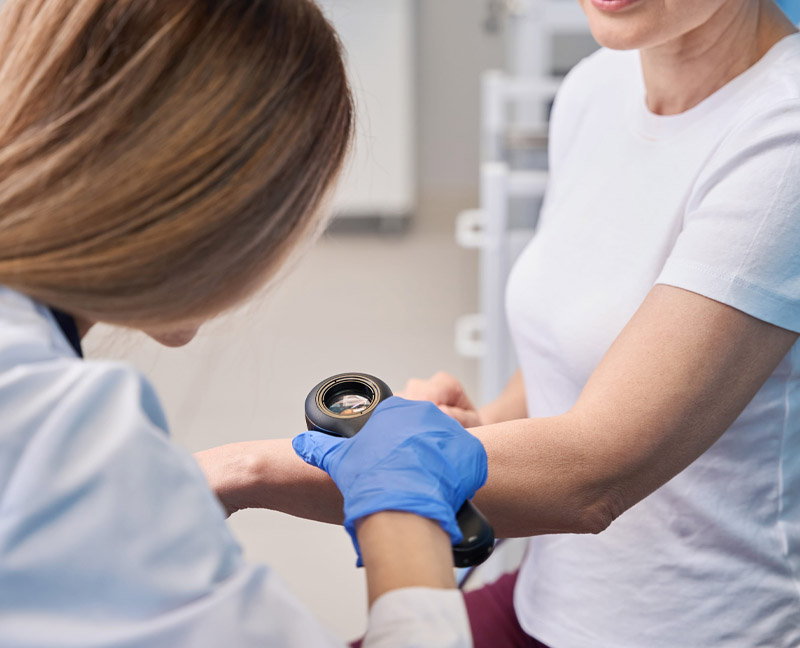
During a professional skin examination, a dermatologist checks for suspicious moles, discoloration and unusual growths. If something appears concerning, a biopsy may be performed.
If melanoma is diagnosed, the pathology report provides important information, including how deeply the cancer has penetrated the skin, known as Breslow depth, and whether the surface has broken down, called ulceration. These findings help physicians determine the appropriate treatment. When detected early, melanoma can often be successfully treated with surgery. More advanced cases may require additional treatments, including immunotherapy or targeted therapy.
Finnegan encourages people at increased risk to discuss regular skin examinations with their healthcare provider. Those with a family history of melanoma should be particularly vigilant and encourage close relatives to discuss their own screening needs.
Sun protection is also important during colder months. Ultraviolet rays can damage skin during skiing, walking, gardening and other outdoor activities. Snow reflects sunlight, and UV rays can penetrate clouds.
“Something as simple as using a facial moisturizer with sunscreen every day can make a difference,” says Finnegan. “People don’t always think about sun protection when they’re outside in the winter, but that exposure adds up over time.”
Choose a broad-spectrum sunscreen with an SPF of at least 30 and reapply approximately every two hours when outdoors.
As the colder months arrive, consider making a skin examination part of your preventive healthcare routine. If you notice a new or changing mole, a sore that won’t heal or an unusual growth, don’t wait to have it evaluated. Skin cancer awareness shouldn’t be seasonal, and early detection can make an important difference in long-term health.
To schedule an appointment with Matthew J. Finnegan, MD, Robotic General & Colorectal Surgeon with Shore Physicians Group, call 609-365-6239. Dr. Finnegan treats patients age 18 and older at 649 Shore Road, Somers Point.
